


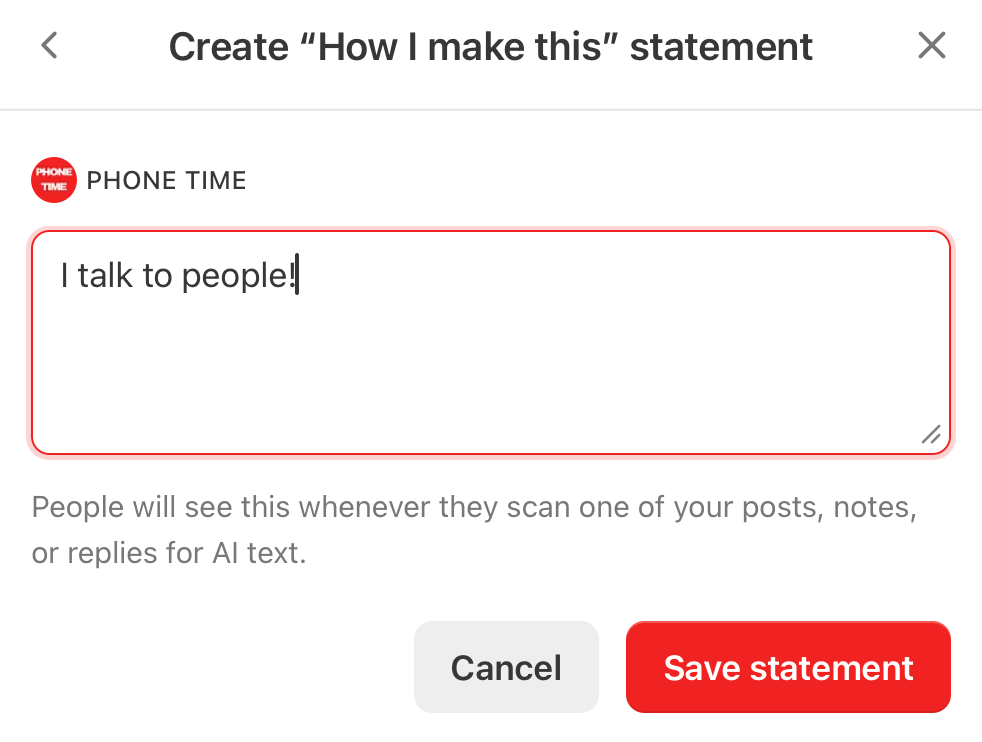
[This piece is about process and touches on AI, so I’ll share that I added a few lines to the section of my about page where I describe my reporting and writing processes (which don’t involve AI) and philosophy.]
Along with Substack’s integrated Pangram AI scanning feature, the platform also launched a “How I make this” feature. It’s a “transparency note” you can add that will come up when people scan your work for AI text.
I think a lot about how to make things. In other words: process. I’ve interviewed probably in the hundreds of people who make creative work, and although I describe myself as an internet culture writer or tech reporter, I find a main driver of my work is actually trying to understand peoples’ processes.
Although there have long been online communities and forums for people who make things, I think short-form video is unique in how it encourages people to share their processes towards not just other hobbyists or makers in the same field, but anyone who happens to stumble upon their TikTok or Reel. While creative process has of course been a key cornerstone of what arts and culture journalists (and many other writers, biographers, and documentarians) sink their teeth into, I think interest in process has become only more explicit this year with arts magazine Totei (“It’s a magazine about the creative process behind the work that we feel is compelling across disciplines, mediums, generations,” editorial director Puja Patel told Semafor) and short-form-driven show “WHAT’S YOUR PROCESS?”
Journalists themselves are thinking more about their own processes, which have often been opaque to audiences. This, I think, is driven in part by the diverse variety of formats for information delivery and presentation that social platforms offer (this is a bit of a simplified analysis). It’s also driven by declining trust in news organizations and an increasing number of people getting news from creators and influencers.
There are a lot of things that make me anxious about the journalism industry, but I’ve found comfort in one thing: the work will never run out. The problem is never that there’s not enough to cover. There are always more people to interview, more events to go to, unexplored angles of a past story.
The limiting factors are time and resources. This means that you are always making tradeoffs. If I cover this event, I’ll miss the other one at the same time. This is true on both an individual and organizational level. Even resourced organizations can’t cover everything.
If you’re dedicating more time to one aspect of the process, other elements or your output in general might suffer (“Remember that neither speed nor format excuses inaccuracy,” reminds the Society of Professional Journalists’ Code of Ethics. Even if a story is factually accurate, more context and detail is often a tradeoff for speed.). If I spend time and energy writing one big story, that’s ten small ones I could be writing instead. And people often underestimate how much production goes into multimedia (whether it’s a TikTok or full narrative podcast) for a relatively small chunk of actual reporting.
I’m frequently reminded by X posts and Instagram comment sections how much of the journalistic process is not widely understood (this isn’t to say that there are not legitimate, informed critiques of specific stories, the way reporting is usually conducted, or the institution as a whole). There are some hints of the lengths a journalist has gone to in their reporting or writing process (“X did not respond after multiple requests for comment”), but even these are easy to miss. Sometimes you’ll interview ten people for a story and end up quoting none of them, which can be frustrating to those sources who were involved in a small slice of your process. Several months ago I came across a post on X from an academic, frustrated that they had given their time to a journalist only to not be included in the final piece. I’m sympathetic to this, as someone who has reached out to academics on tight deadlines for pieces that were ultimately edited down, published in a different format, or even killed for whatever reason. But the process of finding out information can be winding and the obligation is ultimately to write the best story you can, even if that means it turns out different (even much different) than how you imagined when you set out.
The lack of insight readers often have into how piece was reported and written (either or both because of a lack of news literacy or because a news organization has made their process opaque) has, I think, become an increasing problem for news institutions. (At the risk of adding another disclaimer: Journalism has always grappled with a lack of trust from the public.) Traditional practices meant to establish trust (intentionally not putting yourself or your beliefs into your work, waiting until you have the full facts to publish a story) have actually eroded it, as news consumers turn towards creators with both personality and an abundance of hot takes.
I’ve had multiple conversations with journalist friends where we ask some version of the question, “How worth it is putting all this effort into writing crisp, stylistically interesting copy?” Or the more depressing, “Is anyone even reading this?” Aren’t people just going to get this information from a creator, who may or may not be repackaging the work of a journalist via a TikTok green screen video, or an AI summary anyways?
This leads to a lot of cynicism about not only the journalism industry, but the way people consume news. We find comfort in the fact that at least we know that we’re doing the hard work of original reporting that the aggregation and commentary depends on, even if the people consuming that content don’t know or simply don’t care. (This isn’t to say that aggregation or commentary doesn’t have merit. It is just much cheaper to produce.)
But at some point, our job is to inform the public. If what we’re doing now isn’t working, then we should probably try something different. And a lot of journalists are, even with limited resources. You can usually fit a lot less context and information into an Instagram Reel version of a reported story, but the format allows journalists to not only meet news consumers where they are but also give audiences an insight into their process. (Granted, every hour a star reporter gets pulled into to do a short-form video at an institution like The New York Times is probably an hour they would otherwise be making phone calls).
Lots of journalists, especially early career ones, are making content sharing not only their reporting, but their process: what goes into a video shoot, how they get story ideas, how a live broadcast works. This adds more work for the journalists but can help build audience relationships and trust, which can benefit the reporting process down the line.
I’ll wrap up my journalism thoughts by saying that I think the tension between process and product is more evident with journalistic work than other creative outputs. I’ll try to illustrate with a personal example. When I do non-journalism creative work (writing, projects, memes!) I connect deeply with the way artists usually speak about why they make things. Generalizing here, it’s about enjoying the process of making, not about whether what they made is useful to an audience, if they show other people at all. But when I’m doing reporting work, I put more thought into the product. Will people get value out of this? Am I helping people be more informed? I’m a huge fan of journalism formats beyond the traditional lede-nutgraf structure. Even ones that are experimental or just weird. But I think in a mainstream journalism context, non-conventional formats need to do more work to justify themselves.
A few final thoughts…
To return to the “How I make this feature”…it’s something I feel generally positive about. Not only because of the AI factor but because you can learn a lot from other people’s creative processes.
I will note that I think this emphasis on process can be picked up and leveraged by brands in the same way that words like “taste,” “analog,” and “community” have been. I actually see this in how brands use memes. The Dr. Pepper Instagram is a great example.
Making memes is a collaborative process. Image macros often deteriorate and look glitchy over time because people are screenshotting, saving, cropping, and reposting them across platforms. People will often scribble over words to modify a meme rather than remaking the whole thing. When you look at a meme, you can often see multiple layers of additions as the meme has circulated.
Brand memes often look too professional. Even when brands recreate popular templates, they’ll do so with crisply calculated colors, images, and fonts. I think some are beginning to get smart to the inauthenticity of this look. So Dr. Pepper, for example, is experimenting with some of the messier, even uglier aesthetics in an effort to replicate the meme-making process markers that are crystallized in static images. But because we know that these messy elements aren’t rooted in collaborative making over time, as they are for most memes, I think this ends up coming across as tryhard.
I hope this was informative even if you aren’t in journalism, writing, or meme-making! Creativity is in everything. I’d love to hear what you think about creative process.
A non-exhaustive collection of things people have told me about process
“I probably avoided writing a lot of it for a long time, because again I find the process can be so painful. But that’s something I’m trying to work on every day.
Because I don’t know, I get anxious!—I don’t know about you, please tell me if you do too as well—about whether writing is a viable thing to do anymore. I was joking about how sometimes I feel like the only things people read nowadays are captions, memes, or user reviews. And so I get discouraged a lot about writing in general, but I’m kind of coming to a point where I feel like [writing] is such an important practice to me, in terms of reflecting and thinking. The joy of being able to think deeply about something I love is something that can only sometimes happen for me through writing.”
Stefan Chua ơn his review-based project “Local Guide (Toronto, Canada)

“But something I’m thinking about with this project is that I kind of like to deliberately do the hard and arduous things. For this project, I had to really think through every frame, print it out, go through every step myself—bring my body to the Risograph studio to print and scan it and fix all the mistakes. In some ways, I’m trying to celebrate the opposite of vibe coding. Bringing yourself to do the hard work and finding some pleasure in doing that.
With this piece, the theme of shame, it’s not an easy process. You have to go through the difficult feelings to get to the other side.”
Jackie Liu on her browser-based interactive project “i feel so much shame”

“When I’m making a track, I can’t work with the goal in mind. I have to get into the process and let things unfold for a couple of hours. That aspect is something that I learned with music. With a lot of creativity-based things, you can’t force that output, right? You have to sit, let it stew, and let it wash over you.
It’s a very unforgiving process at times, because you never know when inspiration will strike. I think the whole idea is that if you surround yourself in things that you like, the inspiration will start growing.
A lot of it also comes from gaming. I like certain games where you’re not given a tutorial. You just start off and explore through play. It’s the same intention that I want to convey.”
Developer Ajay Menon on how music influences his design process

“I’ll come up with a list of ideas, and then I don’t know how to judge things right after I write them. So I usually wait a few months, and then I come back and look at the ideas that I’ve written and see if any of them seem not corny. Because sometimes I’ll write something and I’m like ‘Whoa.’ And then I’m like, ‘Every person on Earth has had this thought.’ Not that I think I’m particularly innovative—I feel like some of my most successful pieces are just because everyone feels that but hasn’t articulated it quite the same way.
I make a regular habit of going thrifting to find fabric. I also draw a lot from my camera roll. I’ll go back through my camera roll all the time, and I’ll make folders of potential background imagery for a tapestry. It’s a lot of piecing together. I look at my phone all the time—really my art practice is like 50% me looking through my phone and just looking at different files and being like, ‘How could all this work together?’”
Textile artist Lucia Gallipoli on where she gets ideas

“A lot of it comes from recognizing patterns in my own internet habits. I used to spend a lot of time on Wikipedia on my phone trying to fall asleep, because you can just click a link and they’ll send you to a random article.
Over time, I realized I was bookmarking more and more lists that were kind of nonsensical. Wikipedia users seem to really like list pages, but the editors think they’re not informative enough. So people will make list pages, and then the editors will take them back down, and they go up and down, up and down.”
Zinemaker Amy Burek on where she gets ideas

On my phone
I’ve been making Instagram collage posts about early tech memories I have. I’ve posted a few on Substack here too. I hope you enjoy! I’d love to hear what your earliest tech memories are!
I post memes everyday on Instagram.