


Most of us read reviews on a regular, if not daily, basis. Whether it’s Yelp or Amazon, Letterboxd or Fragrantica, reviews create online spaces that remain weird, messy, imperfect. In other words, they’re human.
For writer and artist Stefan Chua, the user review is a container for writing that is not simply functional, but experimental, narrative, and often deeply personal. In his project “Local Guide (Toronto, Canada),” the review is a way “to document our relationships to places,” he says, “in a way that is diaristic, interpretive, and that diverges from quantitative 5-star metrics.”
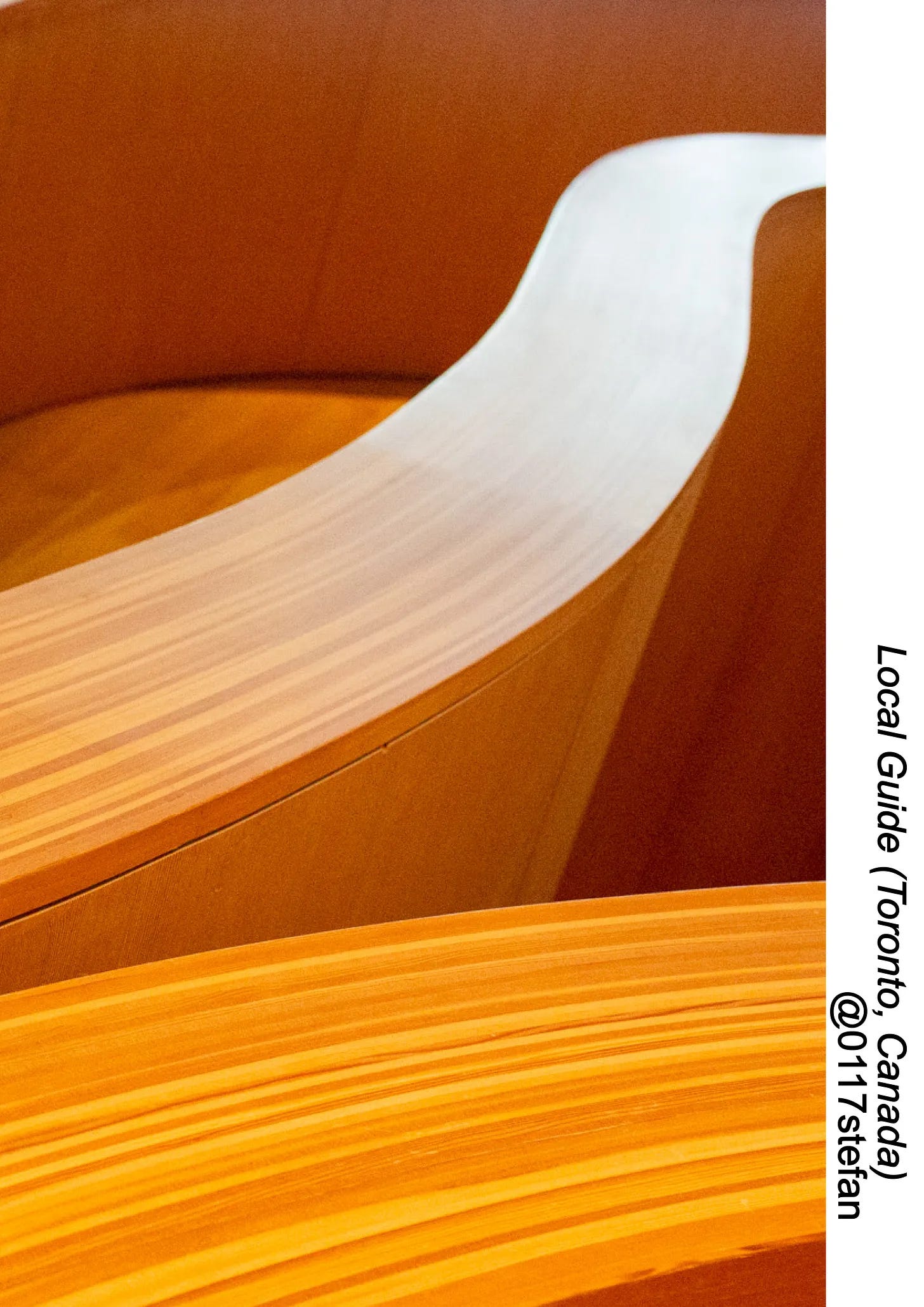
The project contains 52 reviews of places in Toronto: the University of Toronto, an indoor climbing gym, a sushi place, galleries, a soft serve ice cream place, and a magazine shop, to name a few. Chua compiled the reviews in a digital zine where they are meant to be read in order, but he is also in the process of putting them on Google Maps reviews.
Everything in the project is true, drawing on Chua’s personal experiences, photography, and descriptive observations about the restaurants, parks, and other spaces he visited. The project becomes about more than the places Chua stops at, it’s about who he meets and who he becomes along the way.
When interviewing Chua about the project, I remarked to him that to me, it read almost as a form of narrative journalism. Through detailed observation, dialogue, and historical context, Chua takes the review as seriously as one can as a medium, while still finding the space to be playful.
While I usually write up interviews in a pretty traditional Q&A format, Chua and I ended up both sharing our thoughts about writing and the creative process. So I’ve left some of that in. Otherwise, this interview has been edited for clarity and length.
PHONE TIME: How would you describe “Local Guide (Toronto, Canada)”?
STEFAN CHUA: This project is just a collection of user reviews. It’s a collection of my experiences and reflections of my time living in Toronto, meeting different people and going through different things in my life, written all in the form of user reviews.
I really wanted to do something that interacted with the internet and that could live on the internet. With Craigslist missed connections, or those types of entries where anyone could find them on the internet and get this intense insight into somebody’s experience in their life day-to-day. I thought that was so compelling, and I wanted to play with that form. I really wanted to turn [the Google Maps review] into more of a diaristic, almost narrative, form of storytelling. So if you read through the whole thing, there is a narrative arc which is real. I did go through all these emotional things in my life, and I was changed by all these things. I like the idea of having these parts of me kind of scattered across the map for anyone to pick up and see.
PHONE TIME: “Local Guide” covers five to six years of your life. Did you write it along the way or was it written afterward?
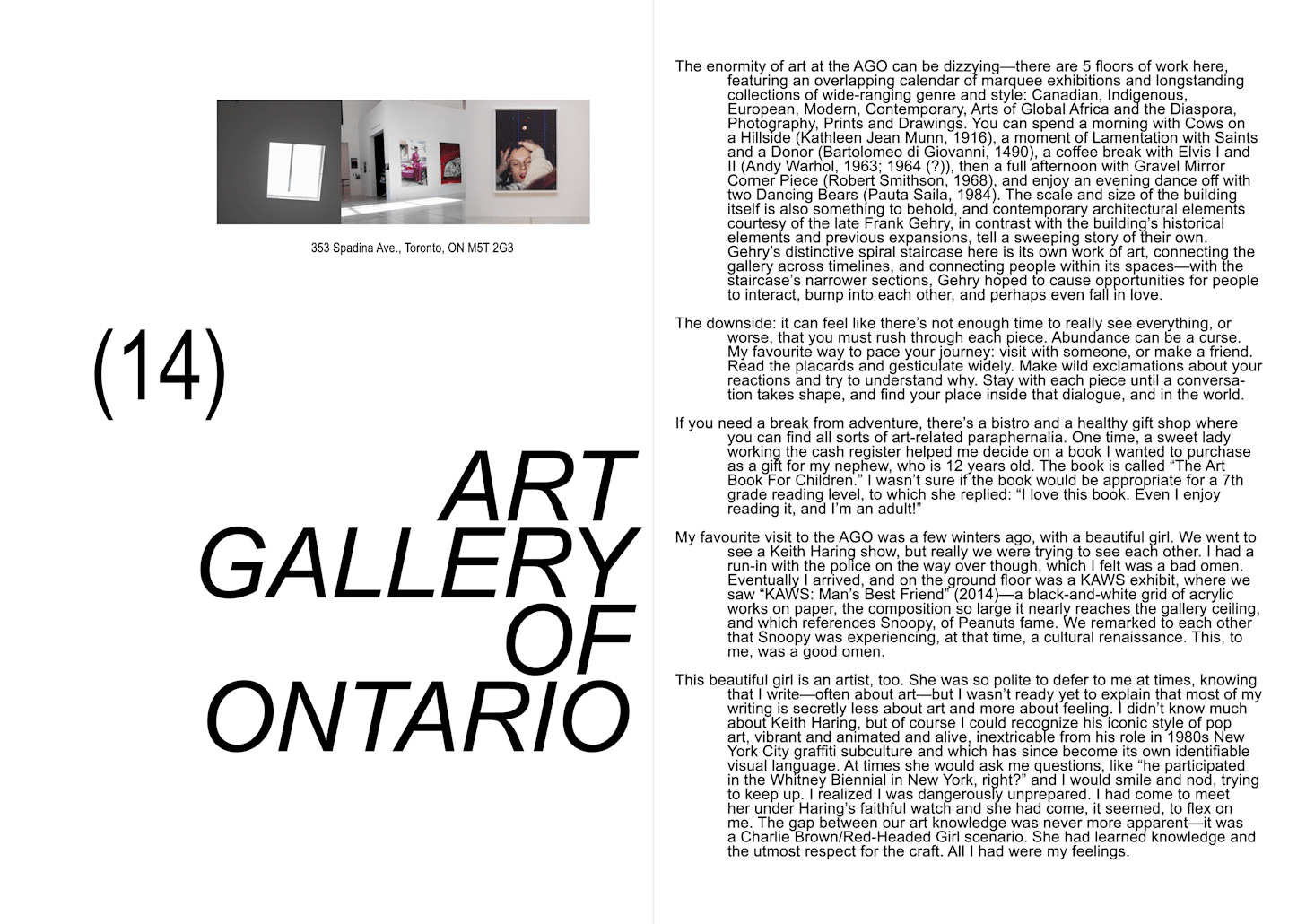
CHUA: The project itself was written mostly after I moved away [back home to Vancouver]. There are some entries I had kind of started or drafted before that I wanted to include. But most of it is entirely right after, just upon reflection. I think I was ready to think about that time in my life and document it.
PHONE TIME: In the project, small themes intermix with bigger themes, like relationships in your life. How did you think about vulnerability and how much you were willing to reveal in the context of a review?
CHUA: I wanted different things to happen. I wanted some entries to be kind of jarring for someone to read as a user review. Like, they’re expecting a deep dive on a food dish or an entrée, and I’m telling them about how I fell in love with a girl or something like that. I thought that was interesting to have that kind of contrast. As well as just having it out there. It’s not anonymous, because my name is attached to it, but it felt a bit freeing to be vulnerable in these, just knowing anyone could read them.
Read more

PHONE TIME: What was the actual process of writing like? Did you find it came easy to you? Or was it difficult?
CHUA: As a writer, I always make the joke that writing is like the most painful thing to do. Like, I hate doing it, but it’s so important to me to do. So the process was interesting from a project level, because I knew I wanted it to culminate in a certain feeling I had about my time there. I knew I wanted to incorporate different things: a few funny and lighthearted, but also some that were very serious and impactful to me. I probably avoided writing a lot of it for a long time, because again I find the process can be so painful. But that’s something I’m trying to work on every day.
Because I don’t know, I get anxious!—I don’t know about you, please tell me if you do too as well—about whether writing is a viable thing to do anymore. I was joking about how sometimes I feel like the only things people read nowadays are captions, memes, or user reviews. And so I get discouraged a lot about writing in general, but I’m kind of coming to a point where I feel like [writing] is such an important practice to me, in terms of reflecting and thinking. The joy of being able to think deeply about something I love is something that can only sometimes happen for me through writing. How do you feel about writing as a practice?
PHONE TIME: For me, it’s like if I get into it, then I can get into it. But probably like for the first 90% of my writing process, I kind of hate it. I’ve noticed this pattern with all of my projects where I’m like, “Why does it take me up until the last minute to be like, 'Oh, I kind of enjoy this?’”
CHUA: It’s the feeling of being like, “I hate this thing that I’m doing so much.” Even the product, honestly, right after I’ve written something, I like, almost never want to read it ever again, because I start to hate it. But it sounds like you come back to it at the end; you start to like it.
PHONE TIME: I think so. And it’s like, it makes you learn stuff about yourself that I think nothing else, for me, has been able to do. Actually, one of my favorite things is talking to people about their creative processes. That’s why I like asking people to do these interviews. Because I’m like, surely someone has to have figured this out. And I don’t think anyone I’ve talked to fully has! It’s just like a weird thing. But I think that’s part of making stuff and you just kind of keep doing it.
CHUA: That’s so comforting to hear to be honest, because I agree. I remember when I was younger, when I first started, I needed everything to be perfect, and nothing ever was. You start to learn that no one ever starts perfect, and everyone’s kind of figuring it out on their own. So it’s very comforting to learn.
PHONE TIME: Another question I have for you. How did you think about the layout and design of the digital zine?
CHUA: I’m not a designer, so when I look at it it feels pretty amateur to me. But I wanted it to look like an art project. So when people interacted with it in that format, they were ready to read it in a certain way. And I wanted to use photography—to give me a reason to take photos throughout the city before I left. I also wanted to include photos with the Google user reviews, because they improve your visibility on that platform.
PHONE TIME: Right, you’re also posting them on Google Maps reviews. How has that process been different?
CHUA: Because I do want it to live on the internet, the end goal was always to have it on these user review platforms. I’ve just been posting the entries on Google Maps reviews. It’s been interesting. I think I’m now a level five Local Guide. Some posts, I’ll get interactions. People will like the reviews, but I’ll have no idea who they are.
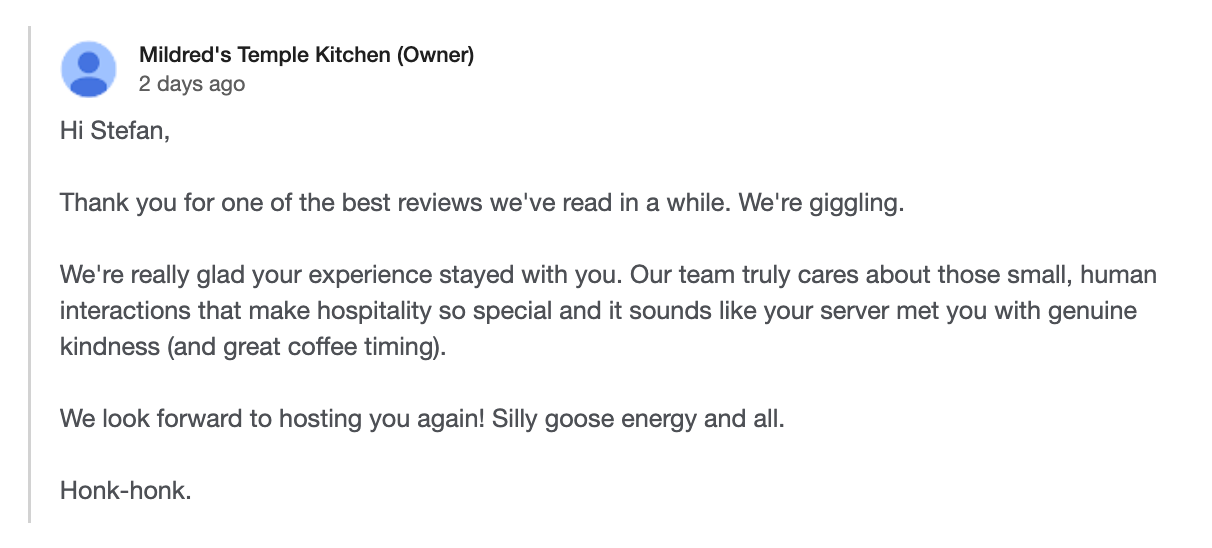
I just posted the one from Medieval Times Dinner & Tournament. I think they respond to every review, but it was really funny to me that they responded to my review [#38 in the zine]. My review was about a girl I had connected with, and I realized I had to move back so there’s only so much time we had together. And she had her birthday party at Medieval Times, which is a very cool thing to do I thought, and she got all dressed up. And my review’s about how much I loved—still kind of do, you know—this part of her that really enjoys this type of thing. And then Medieval Times was just like, “Thank you, good noble. Can’t wait to welcome you back.” I forgot what they used. They were speaking like a Medieval Times person.
Every now and then Google sends me an update on how my reviews are doing. One time I posted a photo, and for whatever reason they selected my photo as the main photo for the place. So I think it moves my review up. I like that people can randomly stumble onto this review and read this part of my life.
PHONE TIME: Outside of this project or your own work, how many reviews do you read on Google Maps or other platforms?
CHUA: I used to not read a ton. And then every time I went out with my friend, before we would go out to eat, they would look up the reviews and ratings for the place. I used to never do that. That’s when I learned that people do actually interact with these reviews quite often. I love when people send me a review that they read, or a Craigslist missed connection that they stumbled upon. One thing I really took away from living in the city, in Toronto, and this is going to sound so corny, but I really love people. And just how weird people can be, and how different people can be so fun and fascinating and special.
So I’m not spending hours. Maybe I should actually, like scrolling through different reviews. But I always love finding one that reveals something to me about someone as a person. It just shows that through all these layers on the internet and through all these platforms, there’s a part of you that still comes through.
You can read “Local Guide (Toronto, Canada)” here and Stefan Chua’s other work here and here.