Today’s issue of PHONE TIME includes: ChatGPT’s version of “Wrapped,” my review of Radu Jude’s overflowing-with-AI film “Dracula,” Pinterest Predicts x Ian Charms, and more zine news.

If you haven’t learned enough about yourself from your Spotify Wrapped or Wikipedia Year in Review or Partiful After Party, you may be in luck. ChatGPT started rolling out a “Your Year with ChatGPT” feature that sums up your interactions. The recap, in the now-ubiquitous story format, takes you through your big themes, chat style, and gives you an “award” based on your chats.
A key difference between a recap of your Spotify activity and your ChatGPT interactions is just how comprehensive the latter has the potential to be. One year of a ChatGPT user’s chats might cover work, relationships, finances, health, creative projects, weird embarrassing questions, etc. While this year’s format was pretty surface-level and cheeky, I could imagine future versions with more depth and detail. The text also reminds me of New Computer’s Dot, now defunct, which responded in warm, creative language. I’ve written before about AI companies branding themselves as more personable and collaborative and think this recap is a step in that direction.
A team at the MIT Media Lab also launched an AI Wrapped as part of a research study. “Your data will be de-identified and you will be able to review your chats before analyses are run,” according to the site’s consent form.

Meme break
I don’t do a ton of longer critical writing. But I wrote this review of Radu Jude’s “Dracula” for a J-school class and think it fits here given the film’s heavy use of AI.
Read more

Opening with AI-generated characters boasting, “My name is Vlad the Impaler Dracula and you can all suck my cock,” at least Radu Jude’s “Dracula” is upfront about what viewers are getting into. It’s probably needless to say that the film, which premiered in August at the Locarno Film Festival, takes more than a few creative liberties with the material of Bram Stoker’s 1897 novel.
We’re soon introduced to a filmmaker (Adonis Tanța), addressing the audience in Romanian from a sparsely decorated bedroom. He is faced with a difficult task: to make a new movie about the count whose story has already been told countless times. Fortunately for him—and at times, unfortunately for the audience—he has at his fingertips a collaborator that will bring to life any idea he can think of.
Over the course of nearly three hours, the on-screen filmmaker uses an AI chatbot to spit out over a dozen different vignettes, the result of various permutations of source material and overarching themes like love, power, and sex. Romping through absurd storylines, the film teasingly pokes at what the filmmaker imagines are his audience’s delicate sensibilities through plenty of crude, laugh-out-loud moments. But for all its stabs at critiquing emerging technology, the commercialization of art, and overly sexed-up media, “Dracula” ultimately lacks any serious bite.
The first and central storyline, which is by far the most compelling of the entire film, centers around a washed-up actor, known as Uncle Sandu (Gabriel Spahiu), and a younger female counterpart, “Vampira” (Oana Maria Zaharia), enacting a sputtering performance as Dracula and Mina—the young woman who falls under the vampire’s curse—to a group of tourists visiting Transylvania. A sexual rendezvous with Sandu is auctioned off to a tourist, which comes to an abrupt end as his failure to perform is played for laughs.
Just as we’ve gotten acquainted with the charmingly pathetic pair, we’re jolted back to our filmmaker, who is not yet pleased with the output and continues to prompt. Over the course of the film, digressions take us to a secret anti-aging clinic for celebrities, Vlad the Impaler’s birthplace-turned-tourist trap, and the office of a video game company ruled by a tyrannical boss named Mr. Vlad.
At many points along the way, the film subjects viewers to what can only be described as sensory gore. In one vignette, a spin on the already kitschy 1992 film adaptation by Francis Ford Coppola, we’re served up a course of grotesque bodily mutations, complete with hyperrealistic AI-generated vulvar and phallic shapes. In later scenes, similarly generated, oversaturated images of wolves, cockroaches, and other pests are set to guttural howling and croaking sounds. The resulting effect is a goop of AI imagery, realistic character-driven scenes, and the blending of the two in moments of jarring glitch.
It is around two-thirds into the film that the endless audiovisual exorcisms have made the point not only clear, but belabored. Our chatbot-assisted filmmaker says that the capitalism-vampiricism metaphor is overdone but devotes an entire vignette to it anyway. And a particularly pornographic storyline toward the end of the film makes it clear that, yes, Jude—the director behind the absurd-embracing “Do Not Expect Too Much from the End of the World” (2023) and “Bad Luck Banging or Loony Porn” (2021)—is trying to have some fun with the audience, in case anyone had any doubts.
Throughout the film, the periodic returns to the odd performer couple are a welcome relief.
While the tourists are ordinarily granted wooden rods at the end of each performance to embark on a mock vampire chase, the performers find that they’ve grown tired of their situation, and decide to actually run away. Their boss implores the guests to catch them for real. Still in Draculanian garb, Vampira and Uncle Sandu hide out, the former taking salacious photos for her OnlyFans, while the vigilantes encroach upon them.
“Dracula” is a film that might have more potency if it was released a year or two ago. But over three years after the rollout of ChatGPT, the dialogue between the filmmaker and his AI chatbot proves predictable and tiring. While there are some funny quips about copyright issues and Elon Musk, watching the filmmaker fiddle about with his iPad chatbot becomes gimmicky, even if to flood the audience with a deluge of what’s been deemed AI “slop” is Jude’s intention. Given Robert Eggers’ recent haunting and innovative adaptation of “Nosferatu” (2024), the filmmaker’s whining about “everything having been done before” seems even more like a lazy excuse.
The vampiric subject matter is an obvious analogy to AI as a soul-sucker, and both the Romanian setting and Jude’s sardonic approach to modern curiosities make for an entertaining, if somewhat dragged out, viewing experience. But the unnamed filmmaker and the smattering of scene characters all prove easily forgettable, and “Dracula” ends up without much to say at all.
Elsewhere online
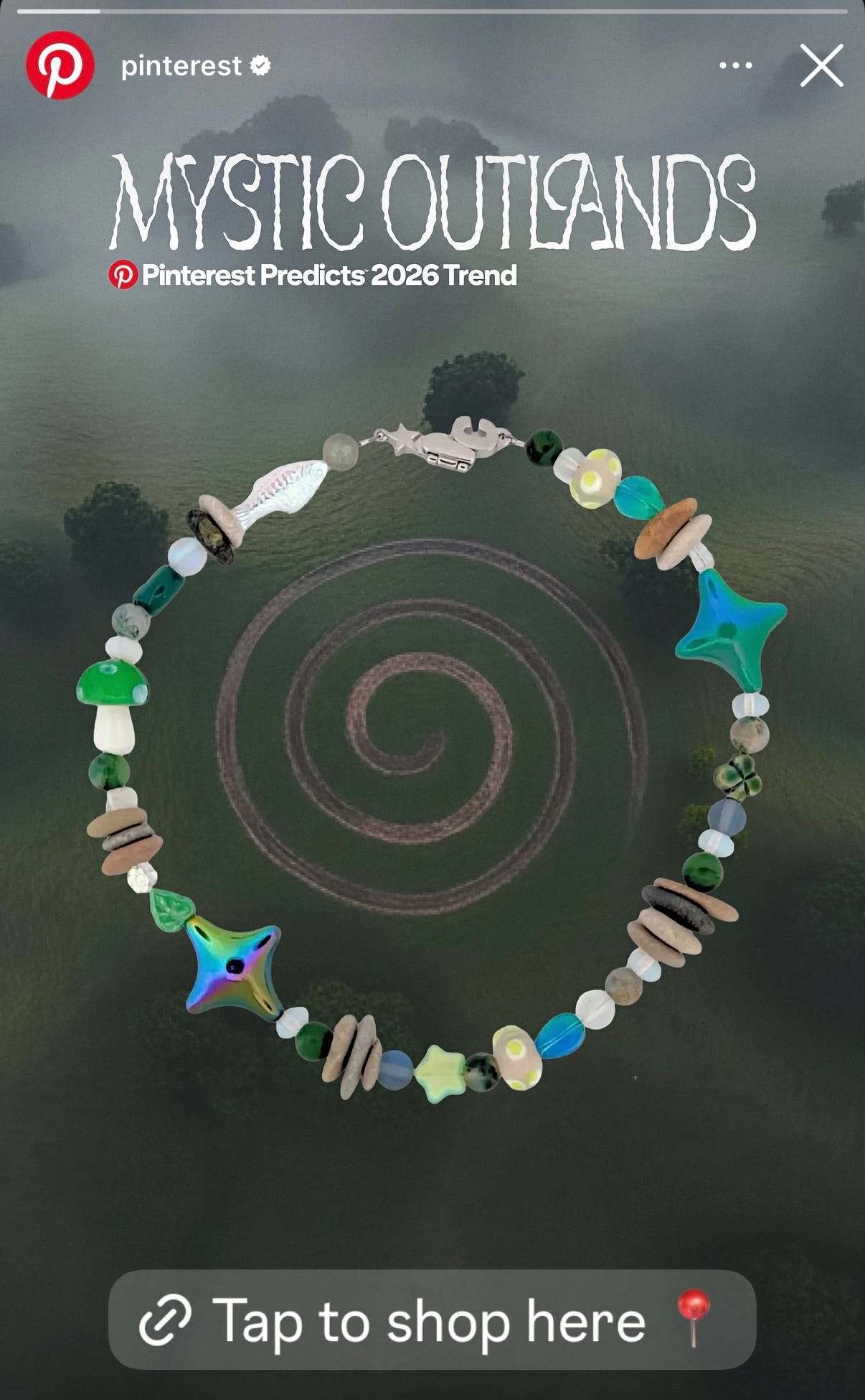
Ian Charms collaborated with Pinterest Predicts to turn five aesthetics into jewelry pieces: Cool Blue, Extra Celestial, Mystic Outlands, Funhaus, and Poetcore. I came across the collab through sponsored Instagram stories, and I think an eclectic beaded jewelry piece is a good canvas for expressing the different Pinterest trends.
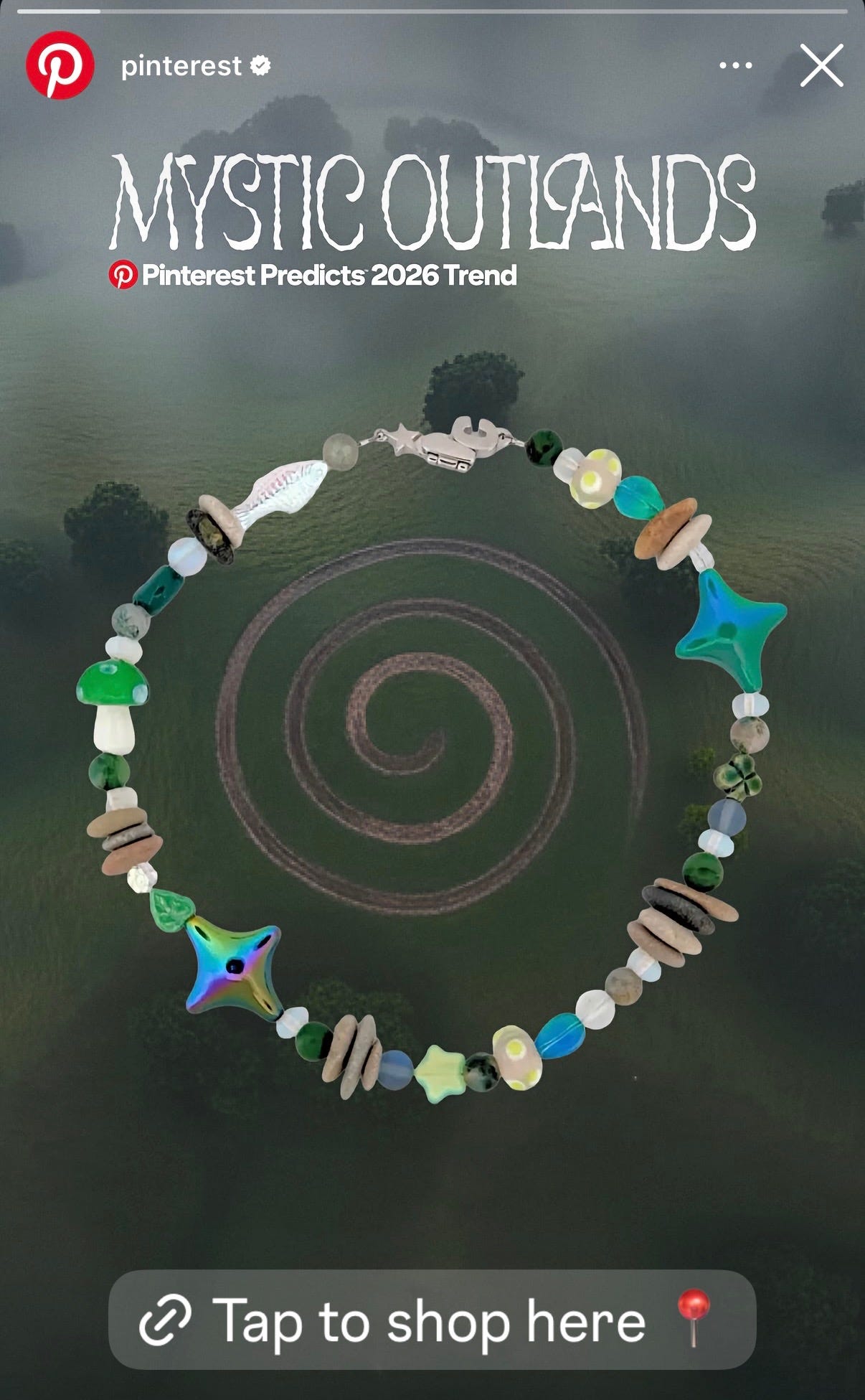
Pinterest describes “Mystic Outlands” as “fairytale meets fever dream.” ZINE NEWS!
404 Media is making a print risograph zine about ICE surveillance tactics. There’s also been reporting about zine-making as resistance in The Guardian and Portland’s Willamette Week. I’ve written many times before about how divides between print and digital and offline and online are often imagined. There’s constant flow between the two in both traditional and social media—the current zine landscape is a great example of this. I think we’re going to see more digital outlets experiment with print projects in 2026.