


Today’s issue of PHONE TIME includes: my review of a new zine from Mozilla Foundation, a Facebook Museum, and The San Francisco Standard’s open call for creators.
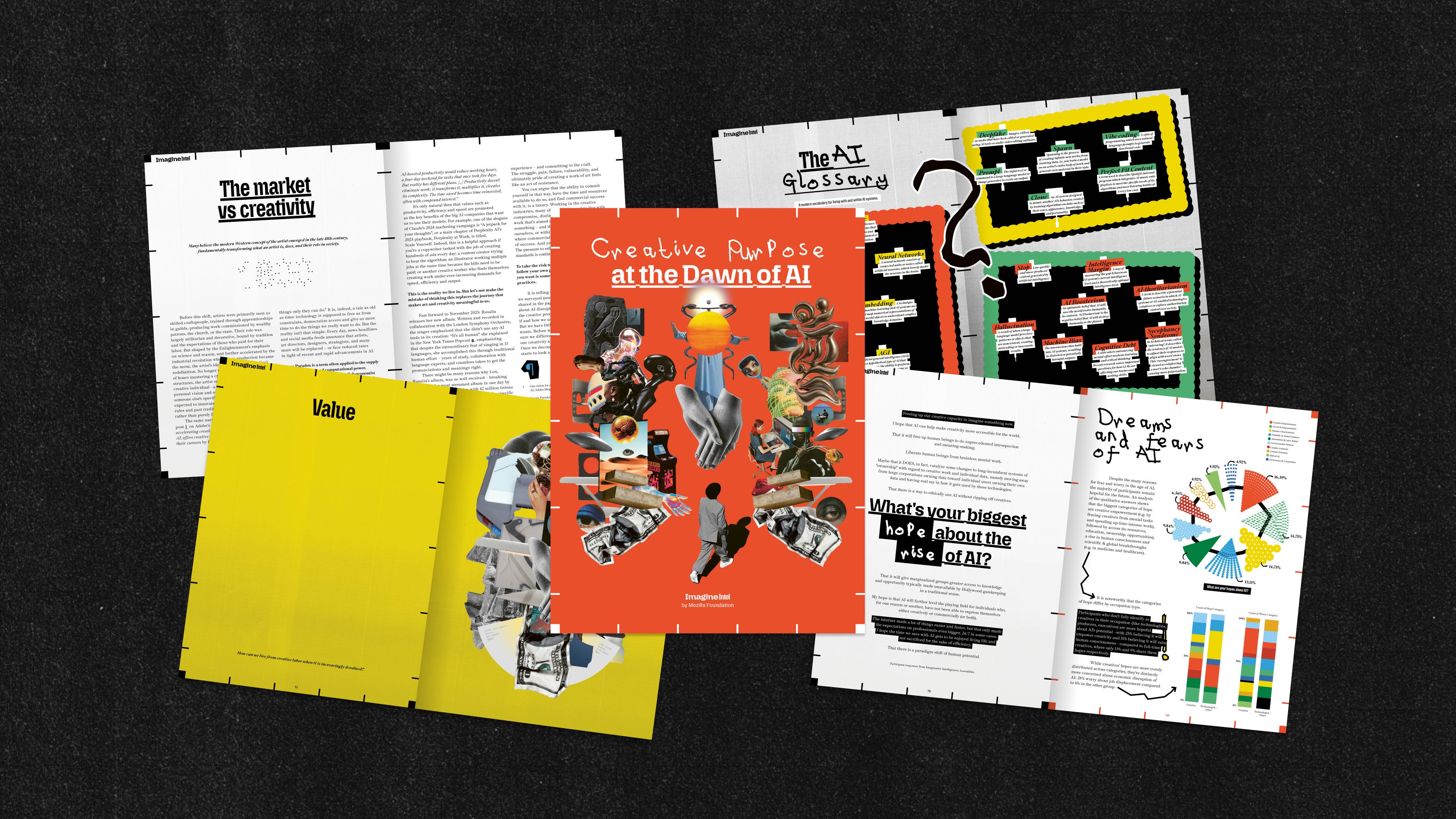
“Doing for AI what we did for the web,” boasts the 2025/26 State of Mozilla report out earlier this week. The report paints a picture of two separate futures—one in which AI companies use the tech to watch and surveil us and another where, aided by AI, “the web is alive again.” Last week, Mozilla Foundation also released a zine (if you have thoughts on what counts as a zine, so do I) called “Imagine Intel: Creative Purpose at the Dawn of AI.” The zine came together through “Imaginative Intelligences Assemblies,” sessions hosted by Mozilla Foundation and the Berggruen Institute during which creatives addressed their relationships with AI. The resulting zine consists of short essays on topics including slop, vibe coding, creativity, and the gig economy.
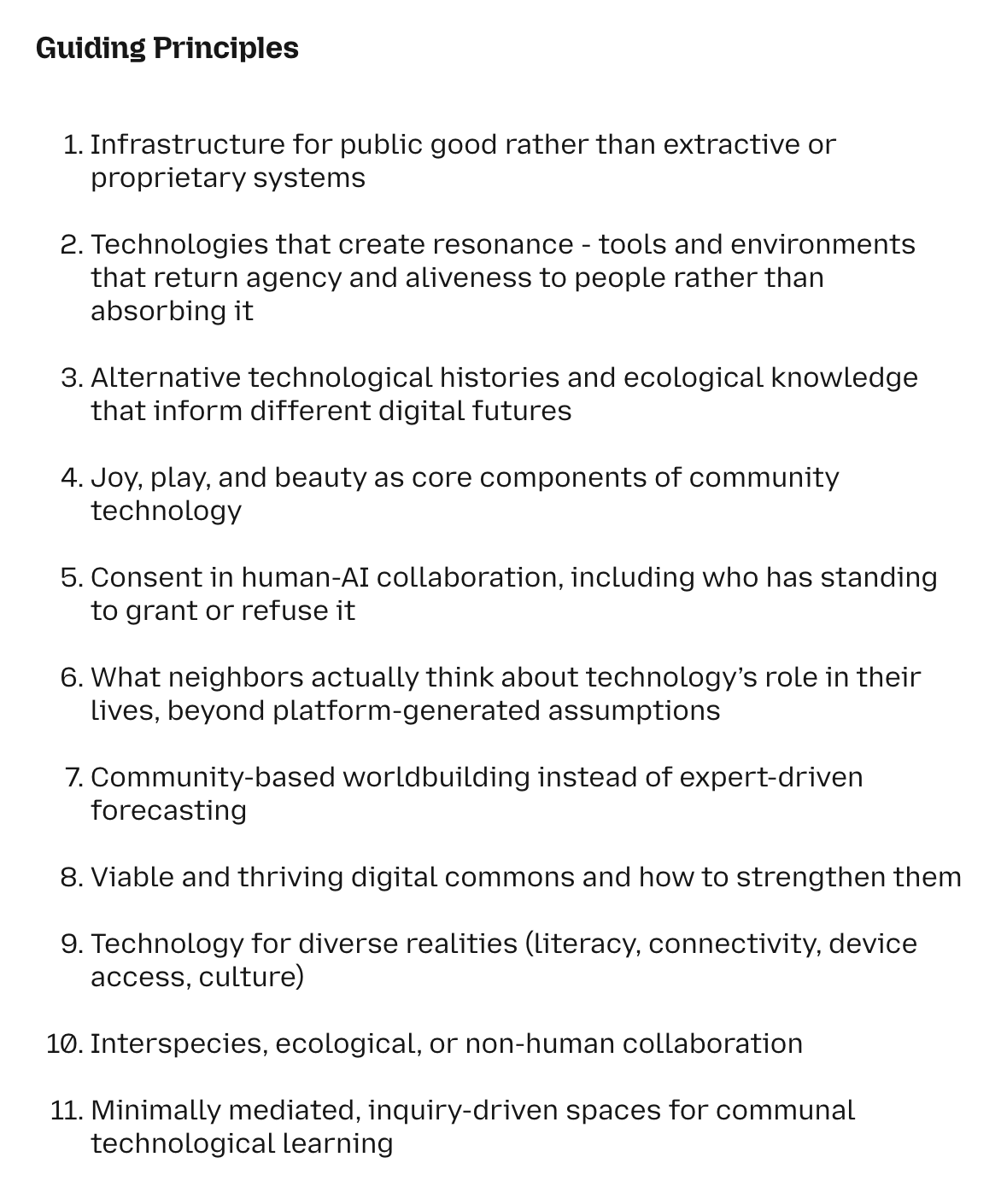
Mozilla Foundation and Rhizome are partnering for the Creative Futures: Counterstructures 2026 creative technologist residency. (Mozilla Foundation had previously partnered with tiat, which I’ve written about for PHONE TIME.) I’ve included a screenshot of the guiding principles, taken from the application, below.
“It’s time to change the narrative of what AI means for artists and creatives” sums up the thesis of the “Imagine Intel” zine, which wades into several popular conversations around AI, working with the terms “slop,” “vibes,” “taste,” and “friction.” One particularly insightful argument: “there’s something about the emergence of vibes as a social currency that feels particularly relevant to AI.” It also spotlights different projects that react to AI in some way—from Tega Brain’s “Slop Evader” (a browser extension only returning results from before the public release of ChatGPT) to fashion label Collina Strada’s collaboration with Baggu, which drew controversy for using AI-generated prints.
The zine concludes with a set of “Hollywood’s Eight Rules for AI” that emerged from the Assemblies, including “Keep Friction in the Creative Flow” and “Design for the Whole Creative Ecosystem.” Where I thought the zine—admittedly, not the best format for at-length digressions—could have elaborated was in how to actually get there. To include artists and creatives in designing technologies is better than completely ignoring them, but there’s a lack of detailed pathways in how to do that.
I appreciate that the zine isn’t prescriptive, is intentional, and offers a variety of possibilities, challenges, and questions. But I think we still need a more developed approach than “The train’s leaving anyways, might as well get on and hope for the best.”
Read more

Elsewhere online
Marissa Memelink wrote last month about the Facebook Museum, a temporary museum created by the Dutch media art collective SETUP installed in Utrecht Central Station in the Netherlands during July 2025 (with plans to diversify and scale in 2026). Among the museum’s works included objects representing Facebook users’ experiences with the platform and a wall where visitors could share their own. — Institute of Network Cultures
An article in Social Media + Society by Skyler Wang and Marco Dehnert argues how AI companion platforms create “on-demand intimacy — intimacy that can be acquired in a truly frictionless manner.” Obviously, the word “frictionless” stood out to me given current conversations about embracing challenge and inconvenience (see: friction-maxxing). “If dating apps once offered acceleration in the search for connection, AI companions promise emotional availability without negotiation,” Wang and Dehnert add. They predict that just as increasingly niche dating app options have proliferated, AI companions will become increasingly customized and personalized to our individual tastes.
The Dartmouth, Dartmouth College’s independent student newspaper, reported that the school approached and paid a student to write an op-ed promoting Evergreen.AI, described as “an AI-powered student wellness platform built to help students thrive.” The newspaper didn’t know at the time that the student, Teddy Roberts, was being paid for the op-ed, which was written in November. In January, Roberts wrote a follow-up op-ed in The Dartmouth explaining what happened.
xAI has a job listing for a “Writing Specialist.” The listing reads, “You will evaluate, refine, and create elite-level writing in a variety of genres and formats to advance Grok’s capabilities in one or more Writing Specialty areas.” Those specialty areas are creative writing, game writing, technical writing, nonfiction writing, copywriting, web writing, grant writing, legal writing, medical writing, academic writing, poetry writing, and journalism. This is obviously depressing, especially as the well of job opportunities in creative writing, media, and journalism dries up. But it also shows how human expertise, judgement, and writing are integral to the development of these AI models—whether tech CEOs want to admit it or not.
The San Francisco Standard has an “Open Call for Creators” on its careers page, as of December. A few things stood out to me about the listing, particularly in how it courts those who may not have a traditional journalism background or experience in freelance reporting. For one, it aims to convince creators who may have their own platforms the value of having a newsroom stamp on one’s work. “This isn't just uploading to your YouTube channel—there are standards. But that's also why it matters more when it publishes,” the open call reads. It also emphasizes doing actual reporting. A line that made me laugh: they aren’t looking for “you reading articles that other people wrote”—a form of information curation and delivery that has become an increasingly popular way to receive news, thanks to TikTok and Instagram “green screen” features. As I’ve written about before, it isn’t only journalists becoming creators or influencers, but influencers and creators also doing acts of journalism. This creates opportunities for new kinds of storytelling and also a lot of potential pitfalls, particularly regarding ethics or conflicts of interest (The Standard’s ethics policy notes “rigorous conflict-of-interest rules” for journalists; this might get more complicated when working with creators who aren’t aware of or used to operating alongside this specific professional code.)
Read more
PBS SoCal is launching a three-year “Community Storyteller Initiative” ahed of the 2028 Los Angeles Olympics and Paralympics. “Each selected storyteller will receive a grant of up to $6500 to produce one short video (5–8 minutes) and a 60-second vertical video optimized for social media,” the application states.
“Heated Rivalry” merch is getting out of control.

If you bought this I want to interview you. UpScrolled is the latest alternative social media app to use “authenticity” as a selling point.



This article comes at the perfect time for a deeper dive into digital authorship and responsibility. What if the blurring lines between creator and journalist compel us to develop entirely new paradigms for intellectual property, especially for models trained on vast human-generated datasets?
tbh why do starts up even try to poach users from the main consumer apps ie ig, Tt, etc.. I obvi wish it would work but it feels so pointless because there will never be enough users constrated on anything else besides what we already have. maybe far in the future idk... also stfu with the authenticity such a meme at this point. anyways ily and your work!