


PHONE TIME TLDR: Instagram has updated its “original content guidelines.” I checked in with meme creators about what that means for them.
At the end of last month, Instagram announced it was updating its “original content guidelines.”
“The same protections we introduced to reels [in 2024] are now expanding to photos and carousels,” Instagram described in a post. “This means accounts that primarily re-upload others’ work without adding meaningful creative input will no longer be eligible for recommendations across Instagram.”
I’ve been thinking a lot about originality online recently. Back in November, I wrote about what I had seen referred to as the “Meme Page Apocalypse.” Meme pages had gotten notifications that their accounts weren’t in line with recommendations guidelines and wouldn’t be shown in places like Explore and Search. People freaked out. Ultimately, head of Instagram Adam Mosseri said in his weekly “ask me anything” that a specific change to recommendations affecting meme accounts would be rolled back.

Researcher Geremia Trinchese interviewed me in March about original content online for his series “BEING A ___ ONLINE,” and I got to elaborate on some of my thoughts in my previous post. I am a journalist but also a meme maker, and the two knowledge practices have starkly different definitions of what “original content” is. (I’ve included my definitions below in response to Geremia’s question.)

What is an ‘original content online’? In our algorithmical age, what does it even mean?
Yeah, the word “original” I think is similar to “authentic” in that what we mean by it is often kind of fuzzy. I think there are probably people in academia or the art world who have thought about this in a lot more depth, but I kind of return to how it’s used in both journalism and meme making. I think it’s also okay for it to be defined differently across different making and knowledge practices.
In journalism, the gold standard is “original reporting.” So getting someone on the phone, doing an in-person interview, or otherwise getting information that other people don’t have, maybe by obtaining a government record or an internal company email. That’s not to say that everything is original reporting (even flagship newsrooms publish a ton of aggregated or listicle-type content), but publications (and individual journalists) live and die by their original reporting. Also, even though criticism usually doesn’t include interviews, a good piece of critical writing produces fresh perspectives because of the authority and knowledge the critic has built up over time.
In meme-making, sometimes people will write something like “all oc” in their bio, meaning original content. What that means exactly might vary to different people. I understand it as the main blocks or elements (text and images) of the meme were added by the poster, even if they’re using a previous template or drawing from other sources. Instagram has guidelines on “original content,” but it’s still kind of fuzzy where memes fit in.
Because the updated guidelines do affect photos and carousels, rather than just Reels, I immediately started thinking about how memes and meme creators might be affected. Defining “originality” in the meme space is particularly challenging, as memes themselves are based on remixing others’ content.
Instagram puts memes in the category of “content you materially edited” (“photos and videos you took” and “content you designed” are two other provided examples of original content). “We understand that defining content you materially edited can especially be complex for meme, fan, and other commentary accounts that regularly use content created by others to add to the cultural conversation on Instagram,” states an Instagram blog post.
Here is what the post specifically said about memes:
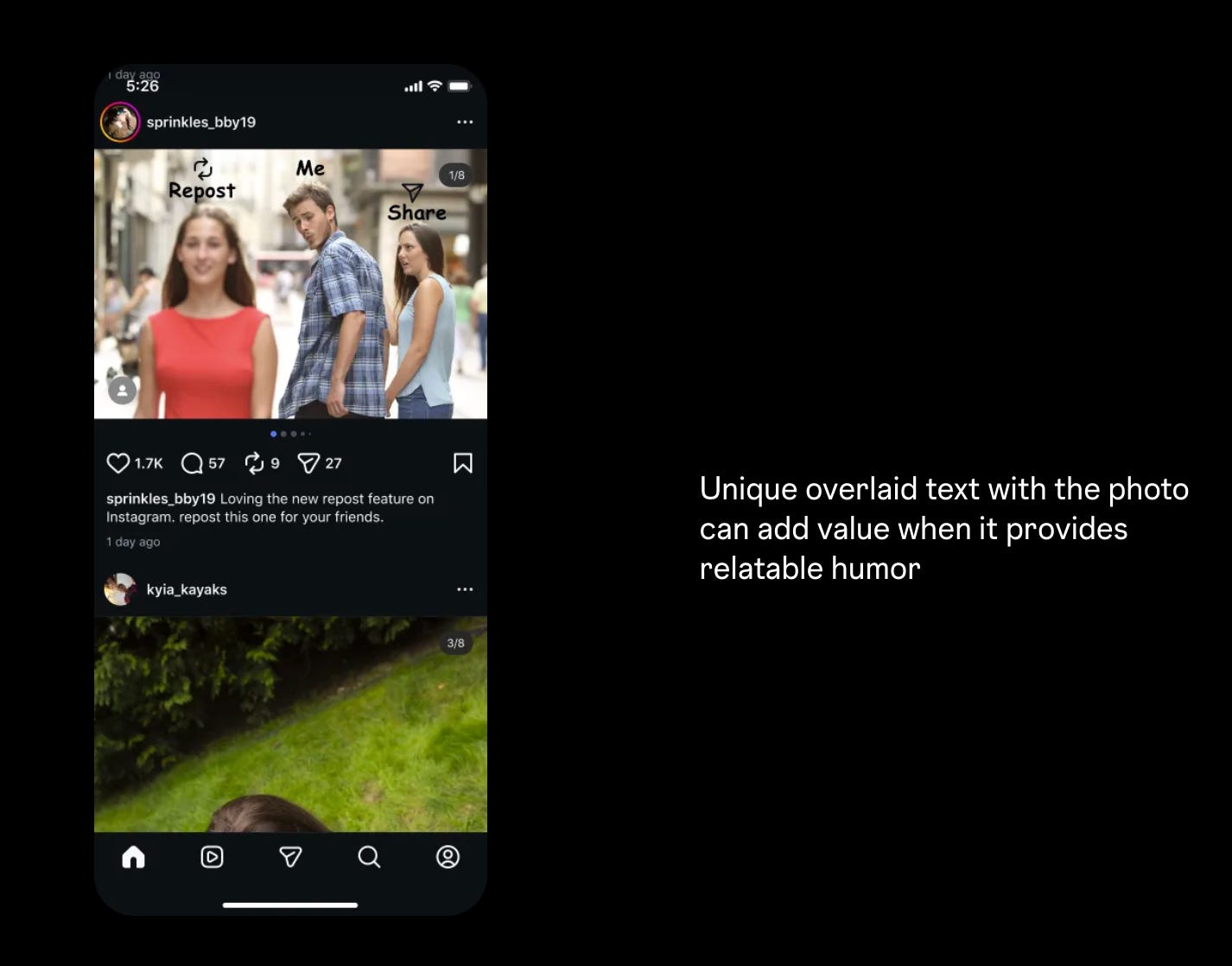
“For example, an original meme transforms another creator’s photo or video. When meme creators add humor, social commentary, cultural references, or a relatable take by incorporating elements such as unique text, creative edits, and voiceover on a photo or video, they’re producing something original. The best meme creators take third-party content and make it unmistakably theirs by layering in a perspective, joke, or context that wasn't there before. This is the kind of creativity we want to continue rewarding.”
Out of all the possible meme examples, I got a kick out of the one chosen: the distracted boyfriend meme. The blog post gives “unique overlaid text,” “relevant captions that include new, material information,” and “voiceover along with the photo when it’s meaningful commentary” as examples of qualifying as “original content.”
Over Instagram direct message, I asked some fellow meme creators their thoughts on both the updated original content guidelines and how they think about originality in general. A common theme amongst those I talked to was a feeling of lack of transparency and clarity from Instagram. It’s a common sentiment whenever Instagram announces changes, one I also saw a lot after Instagram changed the grid aspect ratio last year. Many also had experiences with their memes going viral when they were reposted by bigger accounts, which often didn’t tag or credit them.

This interview has been lightly edited for clarity and length.
Sasha Pohorelov @pysznestopy.pl & @pohorelov
“…I feel like my brain has basically become a mini library (or maybe even a midi one) of every possible meme template available, which helps me instantly connect a funny observation that comes up in a conversation with a friend to a specific meme convention.”
PHONE TIME: Can you describe your meme making process? Where do you get ideas, inspiration, photos, etc. from?
POHORELOV: Amazingly, I manage to keep a pretty pedantic routine when it comes to meme making for my page. For the past three years, I’ve kept a single note on my phone where I write down everything that I believe is/might be funny or at least witty, and once a week (usually on Wednesdays) I sit down at my laptop and go through it. I think an important part of this is that I somehow manage to avoid the Twitter posting black hole, so I don’t feel the urge to post a joke the second it comes to mind. One of the only aspects of my life, when my dopamine mechanisms are actually well-functioning lol. I maintain a pathologically social lifestyle, so my main source of inspiration will always be activities that fall under the umbrella of “European summer core.” On top of that, I feel like my brain has basically become a mini library (or maybe even a midi one) of every possible meme template available, which helps me instantly connect a funny observation that comes up in a conversation with a friend to a specific meme convention. Monkey sees–monkey does–monkey laughs.
PHONE TIME: How do you think about originality in meme making (or more generally in the world of posting)? How important is “originality” (however you define it) to you?
POHORELOV: It’s a tricky question, because I think meme culture is perhaps the most recycled—and I mean that as a compliment—branch of contemporary culture. That “recycling” ranges from translating foreign jokes to completely recontextualizing cultural elements used in such images. Long story short, striving for total originality (no matter how you define it) in memes kind of denies the very foundation of how they function. On my meme page, I make a point of only posting images that I “created” myself, but it would be an insane claim to say that every joke or template is completely original. A few times, I realized that an image I thought I had invented myself was actually suspiciously similar to a tweet I’d seen a few days before posting and then forgotten about. So some people could definitely accuse me of plagiarism and I would agree with them. I wish I remembered more Twitter or Instagram handles of people who made me laugh.
One thing I do still consider important is crediting the author if a) it’s fully known to you, and b) the author themselves asks for it. What I like doing is mentioning a person who inspired me to create an image in the Instagram post caption, because I feel that it is so unfair that we as a society agreed that citing academic sources is based, but citing your friends is optional. Every thought I’ve ever had has been made possible by people who were willing (hopefully) to hear it.
I can’t say that the fact I make all my memes myself comes from some unshakable respect for originality in itself—I simply enjoy dissociating while staring at a blank Canva screen and thinking of the most niche possible way to make fun of the local art scene and my friends’ annoying partners.
PHONE TIME: How do you think about how the meme landscape has changed over time, especially given recent updates from IG on original content?
POHORELOV: … I haven’t seen the notification myself [for the most recent update] and it hasn’t really entered local discourse [in the EU] … Corporations already do a questionable job of trying to control the internet, so even on a purely technical level it’s hard for me to imagine regulating meme pages that repost screen recordings of Ivy Wolk’s stories. Following the logic of banning any “unoriginal” content, they might as well start banning Pinterest, Tumblr, and every other image-sharing platform too. I’ve had my images “stolen” before and what I can say is that it would be nice to be able to somehow complain about that, maybe (?). But once again, I don’t think I would have moral rights to do so, [as] many of the images I use for memes are not technically mine. It creates an insanely complex technological and moral set of dilemmas that I think we’re all too employed to think about.
In a digital landscape where basically everyone at this point has already fallen for an AI-generated video at least once, waging war against meme pages feels dystopian. Like c’mon, is THIS really the problem? Do something about the deepfakes and maybe then come back to stuff like that. Don Quixote fighting windmills as always.
I think the effects of this change are yet to bear out. Mosseri did repond to a few user questions about meme pages on his Instagram story. “To make a piece of content original when you’re starting with someone else’s content, you have to put your own spin on it," he said. “So either green screen on top or your own text or your own story but some way to make it meaningfully different from the original piece of content in a way that you are adding something to say.”
I’ll keep tracking this and report back, so (as always) reach out to me if you have any thoughts.